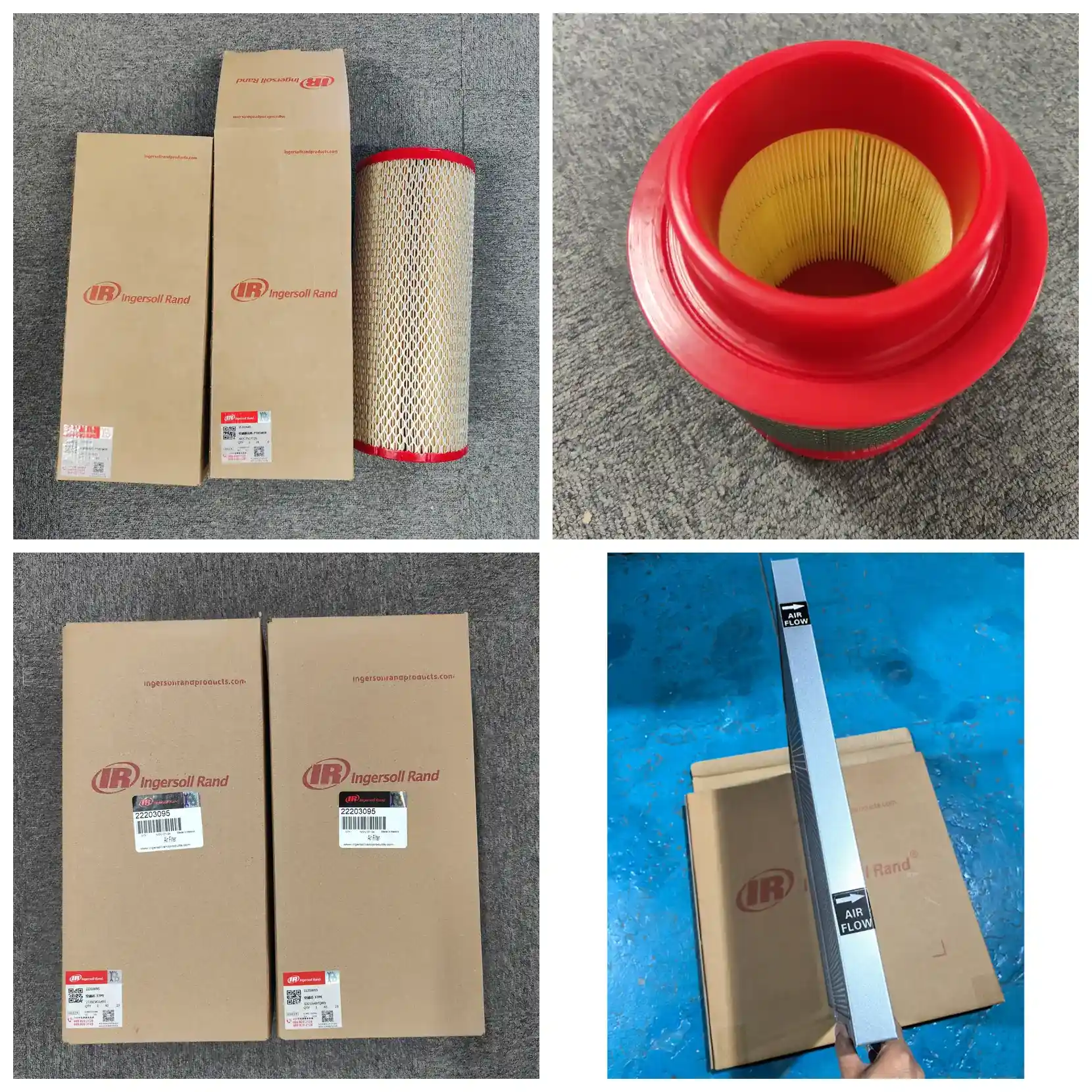
Product
Ingersoll Rand Centac centrifugal air compressor intake filter element 67754101 | Genuine IR Parts
Genuine Ingersoll Rand Centac centrifugal air compressor inlet filter element, drawing number 67754101 (manual figure position 1X9428). Compatible with Centac, Centac C series, and CN series models, net weight approximately 5.4 kg, filtration rating 5–10 μm, efficiency ≥98%, installed upstream of the first-stage impeller to protect the impeller and interstage cooler. Serial number verification of compatibility is supported, global shipping available.
- Export packaging & documentation support
- OEM / ODM customization available
- Sample and bulk order workflow
Product Overview
67754101 — Ingersoll Rand Centac centrifugal air compressor inlet air filter element (Element, Inlet Air Filter).
Installed inside the inlet filter housing, upstream of the inlet guide vanes and the first-stage impeller. A centrifugal compressor relies on the high-speed rotation of the impeller to accelerate the air and convert it into pressure through the diffuser; the air must be sufficiently clean before entering the first-stage impeller. The inlet filter element is the particulate barrier for the impeller blades and the interstage cooler passages.
This product is noticeably larger and heavier than conventional screw compressor filter elements: net weight per unit is approximately 5.4 kg (11.94 lbs), two to three times that of a screw compressor air filter element (typically 1–3 kg), reflecting the high inlet flow conditions of a centrifugal compressor. Centac units can have inlet flow rates of tens to hundreds of cubic meters per minute, and the filter element must provide a larger filtration area to maintain low face velocity and low resistance.
Compared with screw compressors, centrifugal compressors depend more heavily on inlet filtration: the Centac is a 100% oil-free machine, and there is no lubricating oil circulating in the compression chamber to carry away contaminants. Once dust enters, it can only deposit on the impeller, diffuser, and interstage cooler. Fouling on the impeller changes dynamic balance and aerodynamic efficiency, and fouling on the interstage cooler tube bundle directly raises the interstage temperature and lowers overall unit efficiency. Centac units are mostly continuous-operation workhorse equipment, and the cost of a single unplanned shutdown is usually far higher than that of the filter element itself.
Core Specifications at a Glance
| Item | Value |
|---|---|
| Part Number | 67754101 |
| Name | Inlet Air Filter Element / Element, Inlet Air Filter |
| Brand | Ingersoll Rand |
| Applicable Models | Centac, Centac C Series, CN Series centrifugal air compressors |
| Manual Reference | 1X9428 |
| Construction | Dry disposable inlet filter element |
| Net Weight per Unit | Approx. 5.4 kg (11.94 lbs) |
| Filtration Rating | 5–10 μm |
| Filtration Efficiency | ≥98% |
| Recommended Replacement Interval | Approx. 2000 hours or 3 months, or according to the unit inlet differential pressure gauge |
Basic Parameters
| Parameter | Details |
|---|---|
| Part Number | 67754101 |
| Manual Reference (Ref.) | 1X9428 |
| Brand | Ingersoll Rand |
| Product Name | Inlet Air Filter Element / Element, Inlet Air Filter |
| Product Category | Centrifugal compressor inlet filtration (Centac Centrifugal Parts) |
| Applicable Models | Centac, Centac C Series, CN Series |
| Installation Position | Inside the inlet filter housing, upstream of the inlet guide vanes and first-stage impeller |
| Construction | Dry disposable element (Dry Disposable Element) |
| Net Weight per Unit | Approx. 5.4 kg (11.94 lbs) |
| Replacement Interval | Approx. 2000 hours or 3 months, or according to the differential pressure gauge |
Fitment confirmation method: The Centac series model range is very broad (C400–C3000 and larger models), and filter element configurations vary with model and unit version. Precise fitment requires checking against the Ingersoll Rand centrifugal compressor parts catalog using the unit nameplate and serial number, or providing a nameplate photo for our reverse lookup.
Note the distinction from a similar part number: the same Centac parts list also includes 67765362 (Intake air filter core). The two have similar names but are different part numbers; before ordering, please verify the number on the old part itself and do not judge by name alone.
Product Technical Parameters
Filtration Performance Parameters
| Parameter | Value / Description |
|---|---|
| Filtration Rating | 5–10 μm |
| Filtration Efficiency | ≥98% (for particles ≥5 μm) |
| Filter Class | Does not follow the ventilation and air-conditioning filter classification system (EN 779); centrifugal compressor inlet filter elements are characterized per ISO 5011 by filtration efficiency + inlet resistance + dust holding capacity |
| Dust Holding Capacity | — |
Why centrifugal compressors are more sensitive to inlet cleanliness: Centac impellers rotate at speeds of tens of thousands of revolutions per minute, and the blade passages are narrow, so the relative velocity of particles impacting the impeller is much higher than that on screw compressor rotors. Particles of the same size have a more significant erosion effect in a centrifugal compressor; once the interstage cooler tube bundle is fouled, cleaning requires shutdown and disassembly, which is unplanned overhaul work.
Flow and Resistance Parameters
| Parameter | Value / Description |
|---|---|
| Rated Air Handling Capacity | — |
| Filtration Face Velocity | — |
| Initial Pressure Drop (Initial Resistance) | Approx. 0.5–1.0 kPa (approx. 50–100 mmH₂O) |
| Operating Differential Pressure Range | From the initial resistance of a new element to the alarm resistance |
| Alarm Resistance / Final Resistance | Determined according to the indication of the unit inlet differential pressure gauge (Differential Pressure Gauge) |
| Pressure Drop–Energy Relationship | Increased inlet resistance → decreased inlet density → the unit requires more power to maintain pressure and flow → specific power increases |
Pressure drop and energy consumption relationship: The Centac is a centrifugal unit, and its air delivery capacity depends on intake air density. After dust accumulation on the filter element causes the intake negative pressure to rise, the pressure and density of the air entering the first-stage impeller both decrease. To maintain the set discharge pressure and flow rate, the unit must increase speed or power, and the specific power consequently rises. Centrifugal machines are mostly medium-to-large continuous-operation equipment, and this energy loss calculated on an annual basis usually far exceeds the cost of one set of filter elements. This is also why Ingersoll Rand equips centrifugal machines with intake differential pressure indicators.
Structural Dimensions and Installation Parameters
| Parameter | Value / Description |
|---|---|
| Overall dimensions | — |
| Structural form | Cylindrical intake filter element (Element type, installed in filter housing) |
| Net weight per unit | Approx. 5.4 kg (11.94 lbs) |
| Effective filtration area | — |
| Number of pleats / Pleat spacing | — |
| Installation interface | Installed in Centac intake filter housing, end-face compression sealing |
| Sealing form | End-face seal (axial compression) |
Regarding dimensions: Before ordering, please confirm the overall dimensions by any of the following methods: ① Measure the old part (outer diameter, inner diameter, and height — three items, recommended); ② Request the specification drawing for this part from Ingersoll Rand; ③ Provide photos of the old part and measured values for our review. Do not apply other part numbers by analogy based on weight or appearance.
For reference: The net weight of this product is approximately 5.4 kg, which is 2–3 times that of conventional screw compressor air filter elements (1–3 kg), making it a large filter element for centrifugal machines. Do not directly apply other part numbers by weight analogy.
Material Composition
| Parameter | Value / Description |
|---|---|
| Filter media | Imported wood pulp filter paper (commonly used in the industry: US HV or Ahlstrom filter paper) |
| Filter media basis weight | Approx. 130 g/m² |
| Inner and outer frames | Galvanized steel perforated frame (inner frame + outer protective mesh) |
| End caps | Metal end caps (galvanized steel plate) + polyurethane adhesive |
| Seals | Nitrile rubber (NBR) sealing ring |
| Adhesive layer | Polyurethane (PU) hot-melt adhesive |
Operating Condition Tolerance Parameters
| Parameter | Value / Description |
|---|---|
| Operating temperature | −10 ~ +100 ℃ |
| Relative humidity | ≤80% RH, and no condensation |
| Bursting strength | Filter paper bursting strength approx. 200–400 kPa (measured per ISO 2758 paper bursting strength determination) |
| Collapse resistance | The filter element should be able to withstand the unit's intake alarm differential pressure without collapsing |
| Special functions | No flame retardant, anti-static, special coating, or other markings found for this model |
Service Life and Maintenance Parameters
| Parameter | Value / Description |
|---|---|
| Service life | Approx. 2000 hours or 3 months |
| Actual replacement interval | Based on the unit's intake differential pressure gauge; should be shortened in coastal (salt spray), desert (fine dust), and industrial area (process dust) environments |
| Storage shelf life | Approx. 2–3 years (unopened, dry and ventilated conditions) |
Regarding the replacement interval: The standard interval is 2000 hours or 3 months, whichever comes first. For Centac centrifugal machines, it is more reliable to use the unit's intake differential pressure gauge reading as the basis; differences in environmental dust load will cause the actual interval to vary by multiples.
Applicable Standards
| Item | Content |
|---|---|
| Applicable product standard | ISO 5011 (Inlet air cleaning equipment for internal combustion engines and compressors — Performance testing), with evaluation items being filtration efficiency, intake resistance, and dust holding capacity |
| Other commonly referenced standards | ANSI/CAGI ADF 400-1999 (Compressed air and gases), ISO 8573-4 (Compressed air — Measurement of solid particles) |
| Industry commonly cited test standards | ISO 2941 / 2942 / 2943 / 3723 / 3724 / 3968 |
| Standard applicability note | The above ISO 29xx / 37xx series are actually general test methods for hydraulic transmission filter elements. During procurement, if the supplier can only provide hydraulic filter element standards, they should be required to supplement with ISO 5011 or the original manufacturer's specification sheet. |
| Oil-free certification background | The Centac unit served by this filter element is an ISO 8573-1 Class 0 oil-free certified model, and intake filtration is the first line of assurance for maintaining the oil-free rating |
Standard Maintenance and Installation Steps
Centrifugal compressor work differs from screw compressor work: the impeller has a large moment of inertia, and you must wait for the controller to confirm zero speed. A single job takes about 40–60 minutes; depending on housing size, two people may be needed or mechanical assistance may be required (this product has a net weight of 5.4 kg, so stable handling and lifting measures are required).
Shut down, confirm zero speed, and apply lockout/tagout: stop the unit and wait for the controller to confirm zero speed (do not judge by sound). Cut off the main power and apply lockout/tagout. Criterion: the controller shows zero speed and there is no sound of inertial rotation.
Open the intake filter housing: the housing is located upstream of the Inlet Guide Vane. Loosen the end cover latches or fasteners evenly in a diagonal sequence. Criterion: for large housings, someone should hold the end cover before the last fastener is loosened to prevent it from suddenly falling.
Remove the old filter element and inspect the housing interior for dust traces: pull out the old filter element. This product is relatively heavy, so hold it steady and avoid compressing or deforming the filter paper. Focus on observing whether there are dust track bands on the inner wall of the housing; the presence of tracks indicates seal bypass, meaning unfiltered air has bypassed the seal. Criterion: no dust tracks on the inner wall means the seal is good.
Clean the housing and sealing surface: wipe the inner wall, bottom, and sealing surface of the housing clean with a dry, lint-free cloth. Do not blow compressed air forcefully into the housing interior (this will blow accumulated dust into the intake duct). Criterion: no loose dust on the inner wall, and the sealing surface is flat with no pits or corrosion pitting.
Verify the new filter element: compare it item by item with the old part: part number, external dimensions, seal strip integrity, and no damage to the filter paper. Criterion: installation is permitted only when the part number and dimensions all match; the dimensions of this product must be confirmed by actual measurement (see the explanation in Section 3).
Install the new filter element and confirm seating: place 67754101 into the housing and confirm that the bottom is fully seated, the sealing surface fits with no trapped material, and the filter element is centered without skewing. Criterion: the compression marks around the sealing surface are even and consistent.
Reinstall the end cover and check the differential pressure gauge impulse line: reinstall the end cover and tighten it evenly in several diagonal passes. Before startup, confirm that the intake differential pressure gauge impulse line is unobstructed, not blocked, and not frozen. Criterion: the line is unobstructed; a blocked impulse line will give a “false clean” reading, causing the filter element to be used beyond its service life.
Start according to the centrifugal compressor startup procedure and verify: start according to the unit’s specified procedure. After stable operation, read the intake differential pressure; it should return to the baseline range for a clean filter element; listen to the housing for any air leakage sound. Criterion: the differential pressure reading is normal and there is no abnormal noise; record the date, operating hours, and differential pressure reading.
Iron rule specific to centrifugal compressors: the harm of sealing surface bypass is amplified on centrifugal compressors. Screw compressors still have lubricating oil that carries away some particles, but the compression chamber of a centrifugal compressor is oil-free, so all particles deposit on the impeller and cooler. The cost of one seal failure may be one impeller dynamic balance correction.
Frequently Asked Questions
Which machines is 67754101 used on?
Ingersoll Rand Centac centrifugal air compressors; the applicable models are Centac, Centac C Series, and CN Series. The Centac model lineage spans a very wide range, and precise fit requires checking the unit nameplate and serial number.
How do I determine whether it should be replaced?
Two approaches: ① read the unit’s intake differential pressure gauge (the most reliable, reflecting the actual amount of accumulated dust); ② use 2000 hours or 3 months as a reference. The differential pressure gauge criterion takes priority; dust load varies greatly by location, so replacement at a fixed interval either wastes service life or results in overrun operation.
How much does filter element dust accumulation affect centrifugal compressor efficiency?
An increase in intake negative pressure reduces intake air density, and the unit must increase power to maintain pressure and flow, so specific power rises accordingly. The Centac is a medium-to-large unit that runs continuously, and this energy consumption, annualized, usually far exceeds the cost of the filter element.
Can it be blown clean and reused?
No. This is a dry, disposable filter element and is not designed to be cleaned. Back-blowing with compressed air will damage the fiber structure of the filter paper and create channels invisible to the naked eye, allowing unfiltered air to pass directly through, which is more dangerous than not replacing it.
What else should be checked when replacing the filter element?
The inlet guide vane linkage mechanism, intake silencer, interstage cooler tube bundle, and housing sealing surface. For water-cooled models, also pay attention to scaling on the water side of the cooler, which directly affects the interstage temperature. In addition, be sure to check whether the differential pressure gauge impulse line is unobstructed.
Can this filter element be interchanged with a screw compressor air filter?
No. This product has a net weight of about 5.4 kg, which is 2–3 times that of a screw compressor air filter element. Its dimensions, filtration area, and resistance characteristics are all designed for the high intake volume conditions of centrifugal compressors, and the two are not interchangeable.
Are 67754101 and 67765362 the same part?
No. Both part names contain the words “intake filter element” (67754101 = Element, Inlet Air Filter; 67765362 = Intake Air Filter Core), but the part numbers are different. Before ordering, read the number on the old part itself; do not judge by name.
How should the dimensions be confirmed?
For external dimensions, use actual measurements of the old part (outer diameter, inner diameter, and height) as the standard, or request a specification drawing from Ingersoll Rand. Do not apply other part numbers by analogy based on weight or appearance.
Is it in stock? What is the lead time?
Regular stock items ship within 24 hours. Southeast Asia is about 3–7 days, the Middle East about 7–10 days, Africa and Latin America about 10–18 days, and Russia/Belarus about 10–15 days. The specific timing is subject to stock and shipping schedule at the time of inquiry.
How can I be 100% sure the part number is correct?
Three steps: ① check the unit nameplate to confirm it belongs to the Centac series; ② provide the serial number so that we can cross-check it against the centrifugal compressor parts catalog; ③ read the drawing number on the old filter element itself. The third step is the most reliable.
Models Compatible with This Part
This part number is compatible with Ingersoll Rand Centac centrifugal air compressors. The compatibility range is as follows:
| No. | Compatible Model | Description |
|---|---|---|
| 1 | Centac | Main centrifugal compressor series, including multistage multi-shaft gear-driven structures |
| 2 | Centac C Series | Common models include C400, C700, C700e, C1000, C2000, C3000, etc. |
| 3 | CN Series | Another model designation in the Centac family |
Background on the Centac model: Centac is Ingersoll Rand's centrifugal compressed air unit brand, featuring a multi-shaft internal gear drive and multi-stage compression structure, with output flow covering approximately 720–51,000 m³/h (depending on model) and pressure range of approximately 0.7–22.5 bar. The units are 100% oil-free designs, generally certified to ISO 8573-1 Class 0 oil-free, and are widely used in electronics, pharmaceuticals, petrochemicals, textiles, and other industries with high air cleanliness requirements.
Key points for reading the table
- The table above shows the compatible range; individual compatibility must be confirmed with the unit nameplate and serial number.
- The intake system of large Centac units is typically equipped with multiple filter elements; the number used per unit depends on the model. It is recommended to confirm the unit's filter element configuration quantity before purchasing.
- If you are unsure which series the unit belongs to, simply provide a photo of the nameplate, and we will verify by cross-referencing the serial number.
Related components
In the intake and lubrication systems of Centac centrifugal compressors, there are 7 components maintained on the same cycle as the air filter. They are listed below by "location—function—inspection points." For specific part numbers, please refer to the unit's Centac parts manual.
| Component | Location | Function | Inspection points |
|---|---|---|---|
| Intake Air Filter Core | Intake filter housing | Another part number with a similar name to this item (67765362 found in local manuals) | Verify the body number when ordering; do not confuse with 67754101 |
| Differential Pressure Gauge | On the intake filter housing | Indicates the degree of dust accumulation on the filter element and is the authoritative basis for determining replacement timing | Check whether the needle returns to zero properly; the pressure sensing line must be unobstructed and free of ice |
| Inlet Guide Vane Assembly | Downstream of the filter, upstream of the first-stage impeller | Regulates intake volume and intake angle to achieve capacity control | Check the linkage mechanism for binding or looseness; fouling on the guide vanes affects regulation accuracy |
| Intake Silencer | On the intake piping | Reduces intake noise; on some models also serves as airflow straightening | Check for corrosion perforation and detachment of sound-absorbing material |
| Intercooler Tube Bundles | Between compression stages | Reduces interstage air temperature; a key element of centrifugal compressor efficiency | Check for fouling on the air side; for water-cooled models, also check for scaling on the water side |
| Aftercooler | After final-stage discharge | Cools exhaust air to the set temperature | Blocked tube bundles will directly raise the exhaust temperature |
| Gearbox and bearing lubrication system components | Gear speed-increasing box | Lubricates gears and high-speed bearings (isolated from the compression chamber) | Test the oil as required by the unit; pay attention to oil level and oil temperature |
Recommended replacement practice: The maintenance value of a centrifugal compressor centers on "efficiency maintenance." It is recommended to inspect the differential pressure gauge, guide vane mechanism, and intercooler condition each time the intake filter element is replaced, making full use of each shutdown window. Cooler cleaning and impeller inspection should be included in the annual planned maintenance; do not wait until efficiency has noticeably declined to address them.