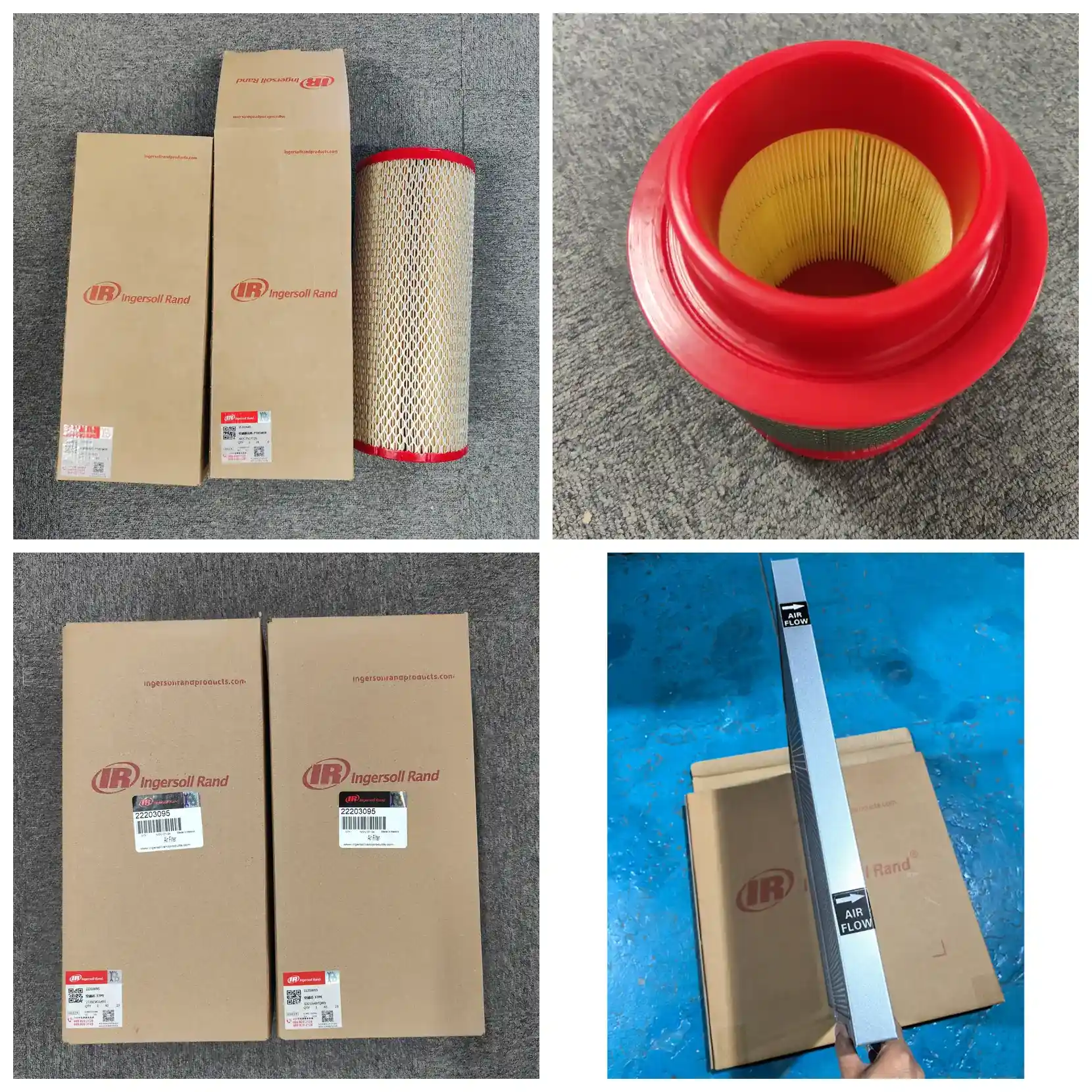
Product
Ingersoll Rand MM350-2S Air Compressor Air Filter Element 47742049001 | Two-Stage Rotary Screw Compressor Intake Filter Element
Ingersoll Rand MM350-2S two-stage compression screw air compressor dedicated air filter element, drawing number 47742049001. Suitable for 350 kW / 8.5 bar(g) / displacement 64.1 m³/min units, filtration accuracy 5–10 μm, recommended replacement interval 2000 hours or 3 months. This model's intake filter element has more than one part number; verification by old part drawing number and installation position is supported to avoid incorrect purchase.
- Export packaging & documentation support
- OEM / ODM customization available
- Sample and bulk order workflow
Product Overview
47742049001 — Ingersoll Rand MM350-2S two-stage rotary screw air compressor intake air filter element (Air Filter Element). This filter element is installed in the unit's external air filter assembly, upstream of the two-stage airend intake. External air is first filtered through it; dust, sand particles, and fibers are trapped on the surface and in the depth of the filter media, and only clean air enters the airend.
Important note: The intake system of the MM350-2S does not use only one filter element part number. The air filter configuration of the same model varies with unit version and configuration quantity, and more than one filter element part number exists in parallel. Before ordering, be sure to verify the drawing number and installation position on the old part itself. Do not judge based solely on the unit model — this is the most error-prone step in parts procurement for high-power units.
Core Specifications at a Glance
- Drawing number: 47742049001
- Brand: Ingersoll Rand / Ingersoll Rand
- Applicable model: MM350-2S two-stage rotary screw air compressor (350 kW)
- Unit displacement: 64.1 m³/min @ 8.5 bar(g)
- Structure type: dry pleated filter element
- Filtration rating: 5–10 μm
- Recommended replacement interval: 2000 hours or 3 months
Technical Parameters
Filtration Performance
- Filtration rating: 5–10 μm
- Filtration efficiency: ≥98% (for particles ≥5 μm)
- Filtration grade: Characterized per ISO 5011 by filtration efficiency + intake resistance + dust holding capacity; the ventilation and air-conditioning filter classification system (EN 779) does not apply
Flow and Resistance
- Rated processing air volume: Matched to the MM350-2S unit intake volume (unit displacement 64.1 m³/min @ 8.5 bar)
- Initial pressure drop: approx. 0.5–1.0 kPa (approx. 50–100 mmH₂O)
- Alarm resistance / final resistance: As indicated by the unit intake resistance indicator (or controller intake vacuum alarm)
- Pressure drop vs. energy consumption: For every 1 kPa increase in intake resistance, unit energy consumption increases by approximately 1%
Relationship Between Pressure Drop and Energy Consumption
Rising intake resistance reduces intake pressure and density. To maintain the set discharge pressure and flow, the unit must do more work, and specific power rises accordingly. Based on a discharge pressure of 0.8 MPa and atmospheric pressure of 101.3 kPa, calculated theoretically by compression ratio: at 0 kPa intake resistance (new filter element), the compression ratio is 8.90 and relative baseline energy consumption is 100%; at 2 kPa, the compression ratio is 9.08 and the energy consumption increase is +2.0%; at 4 kPa, the compression ratio is 9.26 and the energy consumption increase is +4.1%; at 6 kPa, the compression ratio is 9.45 and the energy consumption increase is +6.2%. The MM350-2S is a 350 kW continuous-duty unit. Based on 8000 operating hours per year, energy consumption rises by approximately 6% cumulatively as the filter element goes from new to severely clogged, and the resulting electricity cost far exceeds the cost of the filter element. Large units must have filter elements replaced based on intake resistance, not on the calendar.
Structural Dimensions and Installation Parameters
- Structure type: dry pleated cartridge filter element
- Installation interface: Installed into the air filter assembly, axially compressed
- Sealing type: end-face compression seal (subject to the actual structure)
- External dimensions: subject to actual measurement
Regarding dimensions: This drawing number belongs to a relatively new 11-digit number range, and no reliable dimensional data has been found in the original manufacturer's public materials or third-party channels. Before ordering, please refer to the measured old part: measure the outer diameter, inner diameter (or mounting hole diameter), and overall height, or provide photos of the old part and measurement data for our verification. Dimensions of other filter element part numbers for the same model are not the same; do not apply dimensions across part numbers.
Material Composition
- Filter media: imported wood pulp filter paper (commonly US HV or Ahlstrom filter paper in the industry)
- Filter media basis weight: approx. 130 g/m²
- Inner and outer frames: galvanized steel perforated frame (inner frame + outer protective mesh)
- End caps: metal end caps (galvanized steel plate) + polyurethane adhesive
- Seal: end-face seal ring (oil-resistant rubber)
- Adhesive layer: polyurethane (PU) hot-melt adhesive
Operating Condition Resistance
- Operating temperature: −10 ~ +100 ℃
- Relative humidity: ≤80% RH, and no condensation
- Bursting strength: filter paper bursting strength approx. 200–400 kPa (measured per ISO 2758)
- Collapse resistance: should withstand the unit intake alarm differential pressure without collapsing
- Special functions: no flame-retardant, anti-static, special coating, or other markings found for this model
Service Life and Maintenance
- Service life: 2000 hours or 3 months, whichever comes first
- High-dust environment: based on intake resistance reading; replace when it enters the alarm zone
- Storage shelf life: approx. 2–3 years (unopened, dry and ventilated conditions)
Applicable Standards
- Applicable product standard: ISO 5011 (Inlet air filters for internal combustion engines and compressors — performance testing), with evaluation items of filtration efficiency, intake resistance, and dust holding capacity
- Commonly cited industry test standards: ISO 2941 / 2942 / 2943 / 3723 / 3724 / 3968
- Standard applicability note: The above ISO 29xx / 37xx series are actually general test methods for hydraulic transmission filter elements. During procurement, if a supplier can only provide hydraulic filter element standards, they should be required to supplement ISO 5011 or the original manufacturer's specification sheet
Standard Maintenance and Installation Steps
The external filter housing of a large two-stage compression unit is relatively large, and a single job takes about 30–40 minutes. Two people working together is recommended.
- Shut down, confirm pressure is zero, and apply lockout/tagout: Cut off the main power supply and apply lockout/tagout, and open the air receiver drain valve to release pressure. Criterion: the controller shows system pressure at 0 and there is no residual airflow sound.
- Verify the part number before starting work: Before disassembly, first confirm which position is to be replaced. Criterion: read the drawing number on the old filter element body and compare it digit by digit with the purchased drawing number (do not just look at the part name or model). When more than one air filter part number exists for the same model, installing in the wrong position will cause poor sealing or may prevent it from seating at all.
- Open the air filter housing: Loosen the housing end cap latches or fastening bolts (in diagonal sequence). Criterion: the end cap is not deformed and the latches are not rusted stuck. For large end caps, someone should steady the cap before the last fastener is loosened.
- Remove the old filter element and observe its condition: Pull the old filter element straight out; use lifting assistance when the volume and weight are large. Observe the dust distribution and the condition of the filter paper. Criterion: uniform gray-brown dust accumulation is normal; oily residue on the surface indicates oil carryover upstream and the cause must be investigated; torn filter paper, end cap debonding, or a flattened sealing surface means immediate replacement.
- Clean the inside of the housing: Wipe the housing inner wall, bottom, and sealing surface clean with a dry, lint-free cloth. Do not blow compressed air into the housing interior (this will blow accumulated dust into the intake duct). Criterion: no loose dust on the inner wall, and the sealing surface is flat with no pits. In humid areas, also check the housing bottom for condensate.
- Install the new filter element and confirm seating: After comparing the installation diameter, overall height, and sealing surface type with the old part, install it into the housing and push it until fully seated, with the sealing surface in contact and no trapped material. Criterion: the filter element is centered and not skewed, and the compression marks around the sealing surface are uniform.
- Reinstall the end cap and tighten: Tighten the latches or bolts evenly in diagonal sequence in stages. Criterion: the gap between the end cap and housing is uniform with no obvious skew.
- Start up and verify: Restore power and start the unit. After 5–10 minutes of operation, read the intake resistance. Criterion: resistance is within the new filter element baseline range, and there is no abnormal howling at the intake (abnormal noise usually means the seal is not compressed or the filter element is not seated). Record the date, operating hours, and resistance reading.
Installation iron rule: Do not start the unit before the filter element is seated. Starting directly with no filter element installed or with the seal not compressed is equivalent to letting unfiltered air enter the two-stage rotor directly, which can cause irreversible wear in a short time.
Frequently Asked Questions
Which units is 47742049001 used on?
Ingersoll Rand MM350-2S two-stage rotary screw air compressor (350 kW, 8.5 bar(g), discharge capacity 64.1 m³/min).
Is this the only part number for the air filter on the MM350-2S?
No. This model uses more than one part number for its intake filter elements, and each has a different installation position and function. This is also why this page repeatedly emphasizes "checking the drawing number on the old part itself" — ordering based on the unit model alone is the most common way to make a mistake with this type of part number.
How do I confirm which one I need to buy?
Three steps: ① Read the drawing number from the old filter element itself and compare it digit by digit with the part number you intend to purchase; ② Record the filter's position on the unit (which stage, which side); ③ If the old part has been discarded, provide the unit nameplate and the filter housing markings, and we will trace it back based on the unit configuration. Do not judge by "it looks the same."
How often should it be replaced?
The recommended interval is 2,000 hours or 3 months, whichever comes first. A more accurate approach is to watch the intake resistance reading: schedule replacement once it enters the alarm zone. In high-dust sites, replace earlier based on resistance.
Can the filter be blown clean and reused?
No. This is a dry, disposable filter element designed not to be cleaned. Blowing it out with compressed air only removes surface dust; fine particles embedded deep in the media cannot be removed. The back-blowing pressure can also easily cause filter paper fibers to break or the pleat spacing to deform, creating invisible channels. Continuing to use a cleaned filter is a "looks clean, actually failed" condition — the risk outweighs the benefit.
Why must the air filter be replaced on schedule on this unit?
The MM350-2S is a 350 kW continuous-duty unit. For every 1 kPa increase in intake resistance, energy consumption rises by about 1%; from a new filter to a severely clogged one, cumulative energy consumption rises by about 6%, and the electricity cost calculated at 8,000 operating hours per year far exceeds the cost of a set of filters. At the same time, unfiltered air contaminates both stages of the rotors, the oil separator element, and the lubricant. This is one of the maintenance parts with the most obvious return on investment.
What else should be checked when replacing the air filter?
The intake hose and clamps (for cracks, aging, looseness), the housing sealing surface, the intake resistance indicator (whether the needle returns to position normally), and the oil filter element and oil-air separator element on the same interval. The harm from bypass leakage is equivalent to having no filter installed — checking the hose is one item that cannot be skipped.
Is this filter in stock? What is the lead time?
Regular stock items ship within 24 hours. Southeast Asia about 3–7 days, the Middle East about 7–10 days, Africa and Latin America about 10–18 days, Russia/Belarus about 10–15 days. Specifics are subject to stock and shipping schedules at the time of inquiry.
Is it a genuine OEM part?
The 47742049001 described on this page is an Ingersoll Rand original part drawing number. When purchasing, please rely on the drawing number itself — the part number is the only identity marker that cannot be confused.
Why are dimensions not listed?
This drawing number belongs to a relatively new 11-digit number range, and no reliable dimensional data is available from public sources. To avoid giving incorrect dimensions that lead to purchasing errors, this page does not provide estimated values. Before ordering, please measure the old part's outer diameter, mounting hole diameter, and overall height, or contact us for assistance with verification.
Models This Part Fits
This part is suitable for MM model units in the Ingersoll Rand SSR two-stage 350 kW platform.
| No. | Model | Nominal Power | Discharge Pressure | Discharge Capacity | Notes |
|---|---|---|---|---|---|
| 1 | MM350-2S | 350 kW | 8.5 bar(g) | 64.1 m³/min | Model covered on this page |
Other pressure ratings on the same platform (for identification and to avoid mis-purchase):
| Model | Discharge Pressure | Discharge Capacity | Notes |
|---|---|---|---|
| ML350-2S | 7.5 bar(g) | 69.2 m³/min | Same power platform, low-pressure version |
| MH350-2S | 10 bar(g) | 59.5 m³/min | Same power platform, high-pressure version |
| MXU350-2S | 14 bar(g) | 50.2 m³/min | Same power platform, extra-high-pressure version |
⚠️ This model uses more than one intake filter part number. The MM350-2S air filter uses multiple filter elements depending on unit configuration, corresponding to different filter part numbers. This page corresponds to only one of those part numbers and makes no fitment commitment for the others. How to confirm before purchasing:
- Preferred: Read the drawing number on the old filter element itself and compare it digit by digit with the part number you intend to purchase;
- Next best: Record the filter's installation position (which stage / which side) and provide a photo of the unit nameplate; we will trace it back based on the unit configuration;
- Fallback: Measure the old part's outer diameter, mounting hole diameter, and overall height, and compare by dimensions.
Key Points for Reading the Tables
- The product on this page corresponds to row 1 in the table above, MM350-2S.
- If your unit is an ML350-2S, MH350-2S, or MXU350-2S, please provide the model from the unit nameplate and we will separately verify the air filter part number.
- The same unit model does not mean the filters are interchangeable; the various filter part numbers for the same model cannot be substituted for one another.
Related Components
In the intake and lubrication systems of the MM350-2S, the components on the same interval as the air filter or requiring simultaneous inspection are listed below. When specific drawing numbers are needed, refer to the parts manual supplied with the unit.
| Component | Location | Function | Inspection Points |
|---|---|---|---|
| Other intake filter elements for the same model | Inside the air filter assembly | Corresponds to the filter configuration of this model; part number differs from this page | Distinguish by drawing number when stocking and taking orders; do not assume interchangeability based on model |
| Oil Filter Element | On the main oil circuit | Filters wear debris and sludge from the lubricant, protecting the two-stage rotors and bearings | Replace on the same interval as the air filter; after replacement, check the housing sealing surface for oil seepage |
| Separator Element | Inside the oil-air separator tank | Separates oil mist from the compressed air and returns oil, controlling oil carryover in the discharge | During replacement, also check whether the oil return line is blocked (poor oil return directly causes excessive oil carryover in the discharge) |
| Intake resistance indicator / intake vacuum alarm | Air filter assembly or controller | Indicates the degree of filter clogging and is the authoritative basis for judging replacement timing | Check whether the needle returns to position normally and whether the sensing line is clear; if failed, replace on a conservative interval |
| Intake hose and clamps | Between the air filter assembly and the main unit intake | Ensures the intake path is leak-free with no unfiltered air bypass | Check for cracks, aging, looseness; the harm from bypass leakage is equivalent to having no filter installed |
| Housing sealing surface and end cover | Air filter assembly | Ensures reliable sealing after the filter element is compressed in place | Check for pits and corrosion pitting; check the end cover for deformation |
| Lubricant | Main unit lubrication system | Lubrication and sealing; two-stage compressors have higher requirements for oil quality | Test the oil as required by the unit and replace on schedule; avoid mixing grades |
Recommended replacement pairing: for large two-stage compressor units, it is recommended to include the air filter, oil filter element, and oil-air separator element on the same interval in a single shutdown, avoiding misaligned maintenance intervals and repeated shutdowns. In high-dust sites, prioritize installing high-dust pre-filtration devices; pre-filter elements cost far less than main filter elements and are faster to replace.
Purchasing and Supply
We supply Ingersoll Rand air compressor parts for importers, distributors, and equipment maintenance service providers, with support for part-number verification, bulk stocking, and export packaging. To confirm compatibility, request a quote, or arrange shipment, please provide the part number of the old part, a photo of the unit nameplate, and the required quantity, and we will reply as soon as possible.